

Abstract
- For most people, you'll want to buy a cast-iron kettlebell made from a single piece of cast iron with a wide, smooth handle. It will last for decades and is suitable for all basic exercises.
- Competition kettlebells (steel, with uniform dimensions across all weights) are worth it if you want to build your technique over the long term using a consistent grip geometry.
- Adjustable kettlebells save space, but they're better suited for home workouts than for heavy, continuous use at the gym.
- Getting Started: Women usually start with 8 kg, men with 12–16 kg. It’s better to buy two or three weights rather than a single one.
Buying a Kettlebell: A Guide to Materials, Weight, and Grip
You can recognize the right kettlebell by three things: a solid cast design with no seam on the handle, a wide, smooth handlebar, and a weight that matches your fitness level. Everything else—color, brand, coating—is secondary. Just how effective training with a good kettlebell is was demonstrated in a frequently cited study by the American Council on Exercise and the University of Wisconsin–La Crosse (Farrar et al. 2010): During kettlebell training, participants burned an average of about 20 calories per minute—a strength-endurance stimulus that hardly any other single piece of equipment can deliver in such a short time.
This guide walks you through, step by step, the questions that really matter before you buy: What material? What design? What weight? And what to look for in a handle so your wrists can withstand your workout.
Cast, competition, or adjustable: the three designs
Kettlebells differ less in price than in design. There are three main types, and each addresses a different issue.
Cast-iron kettlebell (the standard)
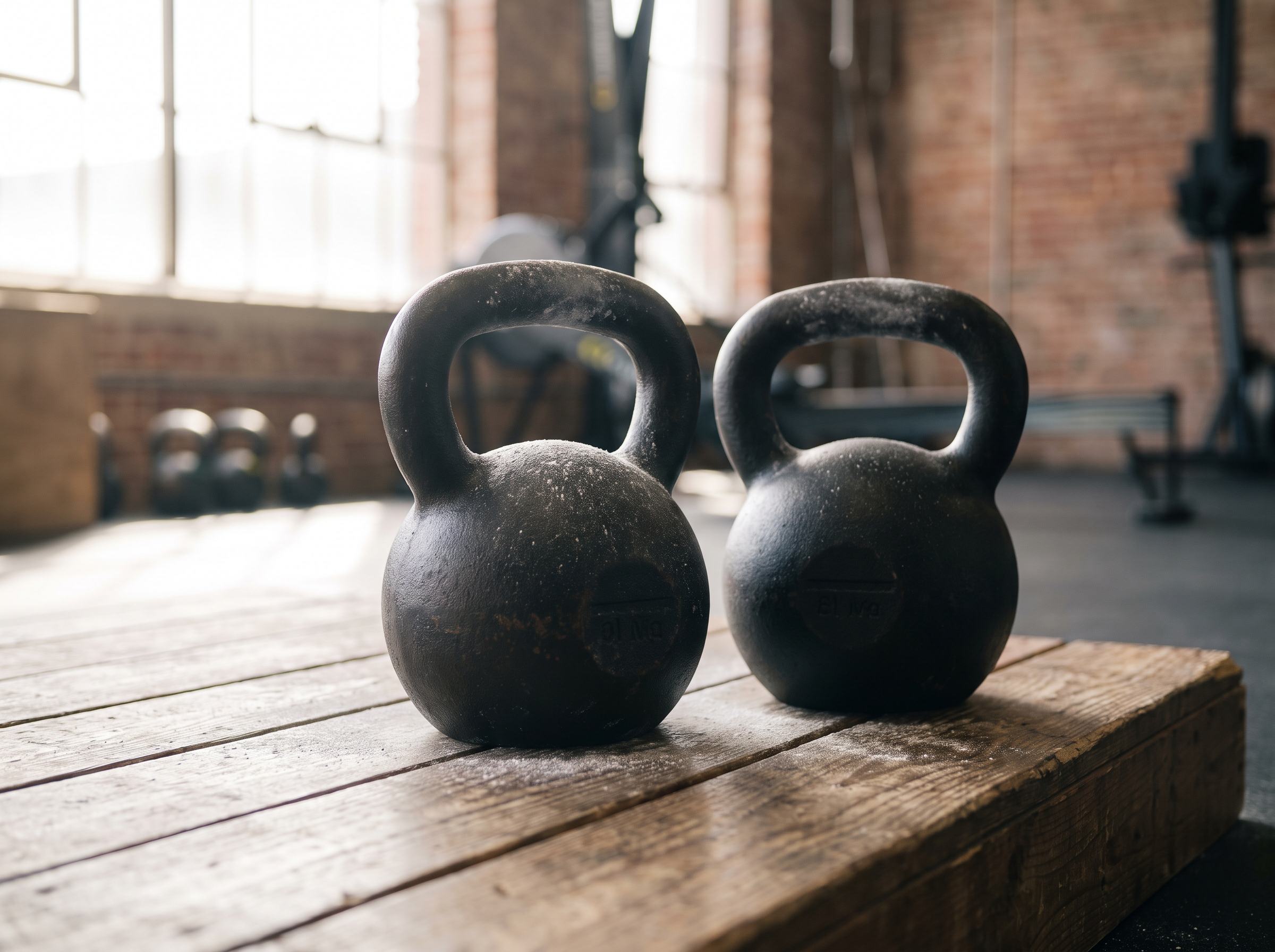
The classic cast iron kettlebell is cast in one piece. The handle and the bell form a single, continuous unit with no welded seam that could break under stress. The kettlebell gets larger as the weight increases—an 8-kg kettlebell is significantly smaller than a 24-kg kettlebell. For beginners and 90 percent of all exercisers, this is the right choice: sturdy, maintenance-free, and affordable relative to its lifespan. Look for an even powder coating that holds chalk well without chafing the skin.
Competition Kettlebell (steel, standard dimensions)
Competition kettlebells (also known as “Competition” or RAW models) are made of steel and have the same ball size and handle diameter across all weight classes. The advantage: Your technique doesn’t change when you switch from 16 to 20 kg—the grip and rack position remain the same. This is invaluable for ambitious athletes and gyms because the movement stays consistent over the years. The downside: a higher price and a slightly thinner handle, which puts more strain on the forearms during very high-volume workouts.
Adjustable kettlebell (space-saving for your home gym)
Adjustable models combine multiple weight settings in a single ball—using a dial or removable plates. They’re the perfect solution if you’re short on space at home. The trade-offs: The center of gravity can shift slightly depending on the setting, the handle geometry is rarely as clean as that of a cast ball, and under the rigors of continuous studio use, the mechanisms don’t withstand the strain as long as a solid-cast ball. For home use and moderate workout volumes, they’re still a smart solution.
Comparison: Which design is right for you?
| Criterion | Cast iron | Competition (Steel) | Adjustable |
|---|---|---|---|
| Ball Size | increases with weight | always the same | varies slightly |
| Shelf Life | very high | very high | medium |
| Space requirements | one ball per weight | one ball per weight | low |
| Ideal for | Beginner & All-Around | Technology & Studio | Home Gym, Limited Space |
What's the right weight?
The most common mistake when buying a kettlebell is choosing a starting weight that’s too light. Unlike with dumbbells, you’re using momentum and engaging large muscle groups—the kettlebell swing, for example, is a hip extension, not an arm lift. That’s why the kettlebell should definitely be a respectable weight.
As a rough guide to get you started:
| Person | Getting Started with Swing/Basics | Precision Exercises (Get-up, Press) |
|---|---|---|
| Women, Beginners | 8–12 kg | 4–8 kg |
| Men, Beginners | 12–16 kg | 8–12 kg |
| Advanced | 20–24 kg+ | 16–20 kg |
Here’s a practical tip: Don’t buy just one kettlebell—get two or three different weight classes instead. You’ll need a lighter weight for precision exercises like the Turkish get-up and overhead press, and a heavier one for swings and deadlifts. If you buy only one kettlebell, you’ll either be under- or over-challenging yourself in half of all your exercises.
The Handle: The Most Underestimated Detail
The grip determines whether your kettlebell workout is enjoyable or ends with blisters and sore forearms. Three points are important:
Diameter. If it’s too thick, your forearms will tire out before the target muscles are exhausted when doing high-rep sets. If it’s too thin, the ball will dig into the palm of your hand. A diameter of around 33–35 mm fits most hands.
Surface. The grip should be smooth enough so that the ball rotates cleanly around the hand during racking and when flipping it over, but grippy enough that it sits securely with a little chalk. Aggressive, rough coatings look sturdy, but they tear the skin when you swing a lot.
Window. The space between the grip and the ball (the “window”) must be large enough for both hands to fit inside during a two-handed swing without getting pinched.
Coating and Finishing: The Small Details
Two balls of the same weight can feel completely different—the difference lies in the craftsmanship. Pay attention to three things. First, the grip edges: They must be cleanly deburred. A rough seam on the grip, like the kind found on cheap cast balls, will tear your skin during swings. Second, the finish: A matte powder coating holds chalk well and provides a secure grip even with sweaty hands, while a glossy finish becomes slippery. Third, the base: It should be wide and flat so the ball doesn’t tip over during grip push-ups or renegade rows.
Especially with color-coded lines like the “ tiguar ” kettlebell series, you can tell the weight just by the color—which is handy at the gym, where multiple users want to quickly grab the right kettlebell without having to look for the embossed markings every time.
Kettlebells for the home gym or the gym?
The location influences the purchasing decision. Space is a key factor for a home gym: Here, two to three fixed cast-iron kettlebells are often sufficient—or one adjustable one if every square meter counts. Different rules apply to commercial gyms. There, the kettlebells are used by many people every day, are dropped more frequently, and must remain durable. Fixed competition or cast iron kettlebells are the right choice here—adjustable mechanisms wear out too quickly with continuous use. For gyms, it’s also worth investing in a continuous weight series (such as 8, 12, 16, 20, 24 kg) to cover every training level, as well as a suitable rack that keeps the kettlebells organized and secure.
Shopping Guide: What to Look for in Your Shopping Cart
As you browse our selection, you’ll find cast-iron models in finely graded weight classes—such as the color-coded “ tiguar ” kettlebell series and competition models made of raw cast iron. To get started, choose two or three weights from the kettlebell collection; if you’re planning your entire free-weight setup, be sure to also check out Dumbbells & Kettlebells and the Strength Training category. Before purchasing, make sure the kettlebell has a flat, stable base—it shouldn’t wobble on the floor so that Renegade Rows and push-ups using the kettlebell are safe.
When you shop at Kraftathlet, you're buying from an authorized dealer with a manufacturer's warranty —and you'll benefit from carbon-neutral shipping and a 30-day return policy in case the weight isn't quite right.
Common Mistakes When Buying Kettlebells
It was too light. The 4-kg decorative ball from the supermarket isn't heavy enough for a serious swing. It's better to go a size heavier than too light.
I only bought one shot. Ballistic and slow exercises require different weights. Two levels are the practical minimum.
Coating ignored. A painted ball becomes slippery on the grip bar as soon as your hands start to sweat. Powder coating or bare, cleanly deburred steel provides a better grip.
Adjustable for intense gym use. In commercial settings with continuous use and many users, solid cast-iron balls are the more durable and safer choice.
Frequently Asked Questions
As a beginner, what weight should I start with?
Women usually start with 8 kg for swings, while men start with 12–16 kg. For slow, precision exercises like the Turkish get-up, use a lighter weight. A clean hip extension is more important than the exact weight.
Cast or competition kettlebell—which is better?
For beginners and all-around training, a cast-iron kettlebell is perfectly sufficient. Competition kettlebells are worth the investment if you want to train for years using kettlebells with consistent handle and ball geometries—for example, at the gym or for kettlebell sports.
Are adjustable kettlebells useful?
For home use where space is limited, yes—you can replace several balls with just one. For continuous studio use or very high swing volumes, solid cast balls are more durable and safer.
How many kettlebells do I need?
Most programs cover two to three weight levels: a lighter one for presses and get-ups, a medium one for proper form, and a heavier one for swings and deadlifts.
How hard is kettlebell training, really?
Very intense: In the study by Farrar et al. (2010), participants performing kettlebell swings reached about 87 percent of their maximum heart rate. Kettlebell training combines strength and endurance in a single movement—which is why short sessions are sufficient.
Conclusion
Buy a cast-iron kettlebell made from a single piece of cast iron with a smooth handle; choose a weight that’s better too heavy than too light, and plan for two to three weight increments right from the start. Competition kettlebells are the investment for consistent form, while adjustable models are the space-saving solution for your home gym. Not sure which combination fits your goals and your space? Reach out to us via our contact page —we’ll put together a set that fits your workout.